Read a sample report before you buy
This sample report was built from a made-up charity, the Red Panda Protection Group (opens in a new tab). Every name, number and finding in it is fictional. It shows you exactly what a Self Audit report looks like, page by page.
Fictional charity. For illustration only.
All pages
- Cover
- About Fundraiser In The Room
- Page 1: Summary
- Page 2: The eight Forces
- Page 3: A note for your finance director
- Page 4: How the system interacts
- Page 5: Strategic Coherence
- Page 6: Income Architecture
- Page 7: Donor Value Creation
- Page 8: Capability Infrastructure
- Page 9: Insight and Intelligence
- Page 10: Operational Flow
- Page 11: Leadership and Governance
- Page 12: Learning and Adaptation
- Page 13: How sure we are
- Page 14: The thin-evidence scores
- Page 14, continued
- Page 15: All forty scores
- Page 16: What to do, and in what order
- Page 17: Conclusion
- Back cover
How the report is laid out
The report is an A4 document. You read it on screen one page at a time, and you can download it as a PDF. It has a cover, a page about Fundraiser In The Room, seventeen numbered pages and a back cover.
Report page 1: Summary and overall score
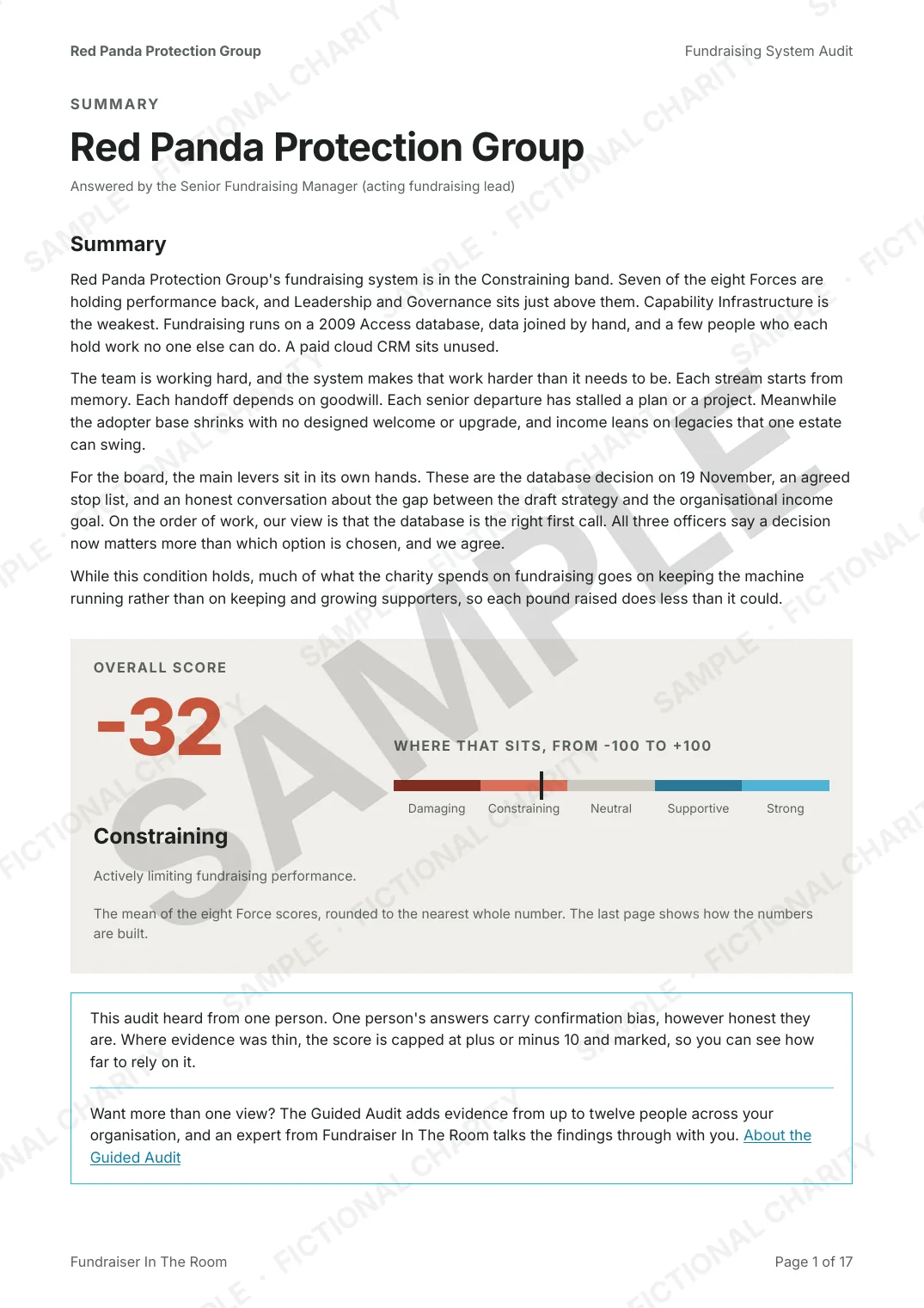
The report opens with the overall score and its band. The score is the average of the eight Forces, with nothing added or taken away. Under it is a short Summary of what the evidence shows.
This page also carries a note about reading one person's view. A Self Audit is answered by one person, so the report says so up front.
The eight Forces on one page
Next you see all eight Force scores together, each with its band, so you can tell at a glance which Forces help and which hold income back.
Report page 3: A note for your finance director
This page is written for your finance director. It reads the eight Forces as drags on value. It describes value lost and never puts a pound figure on it. It's there because finance directors often control the budget for the changes fundraising needs.
Each Force in detail
Each Force gets its own section. You see its five sub-dimension scores and the evidence behind each one. Where a score is capped because the evidence is thin, it's drawn hollow, with the uncapped value marked. You can see what we found and what we couldn't find.
The compound loops
Some problems feed each other. Weak data can slow learning, and slow learning can keep data weak. This part of the report shows where Forces are making each other's problems worse in your charity.
The forty scores
All forty sub-dimension scores on one page, for anyone who wants the detail behind the Force scores.
How sure we are
This page lists every score where the evidence was thin. That might mean it came from one source, or it was inferred from something missing. Those scores are capped at plus or minus 10. We'd rather tell you where we're less sure than hide it.
The plan: Now, Next and Then
The plan sets out what to do in three phases. Now covers what to start straight away. Next covers what follows once that's under way. Then covers longer work. It's built from your own scores and evidence.
The rounding rule
The overall score can come out with decimals, because it's a mean of eight numbers. It's shown as a whole number, and this page explains the rule in full. The overall band is taken from the whole number you see, so the number and its label always agree.
The conclusion and next steps
The report closes with a short conclusion. The last page has a box about the Guided Audit. If you book one within 90 days of your report's release, the £495 you paid (before VAT) comes off.
About the Red Panda Protection Group
The Red Panda Protection Group (opens in a new tab) doesn't exist. We created it to test the audit and to show you a full report without sharing anyone's real results. Any likeness to a real charity is by chance.
Want one for your own charity?
The Self Audit gives you the same report, built from your own answers and documents.